Why offshore is different
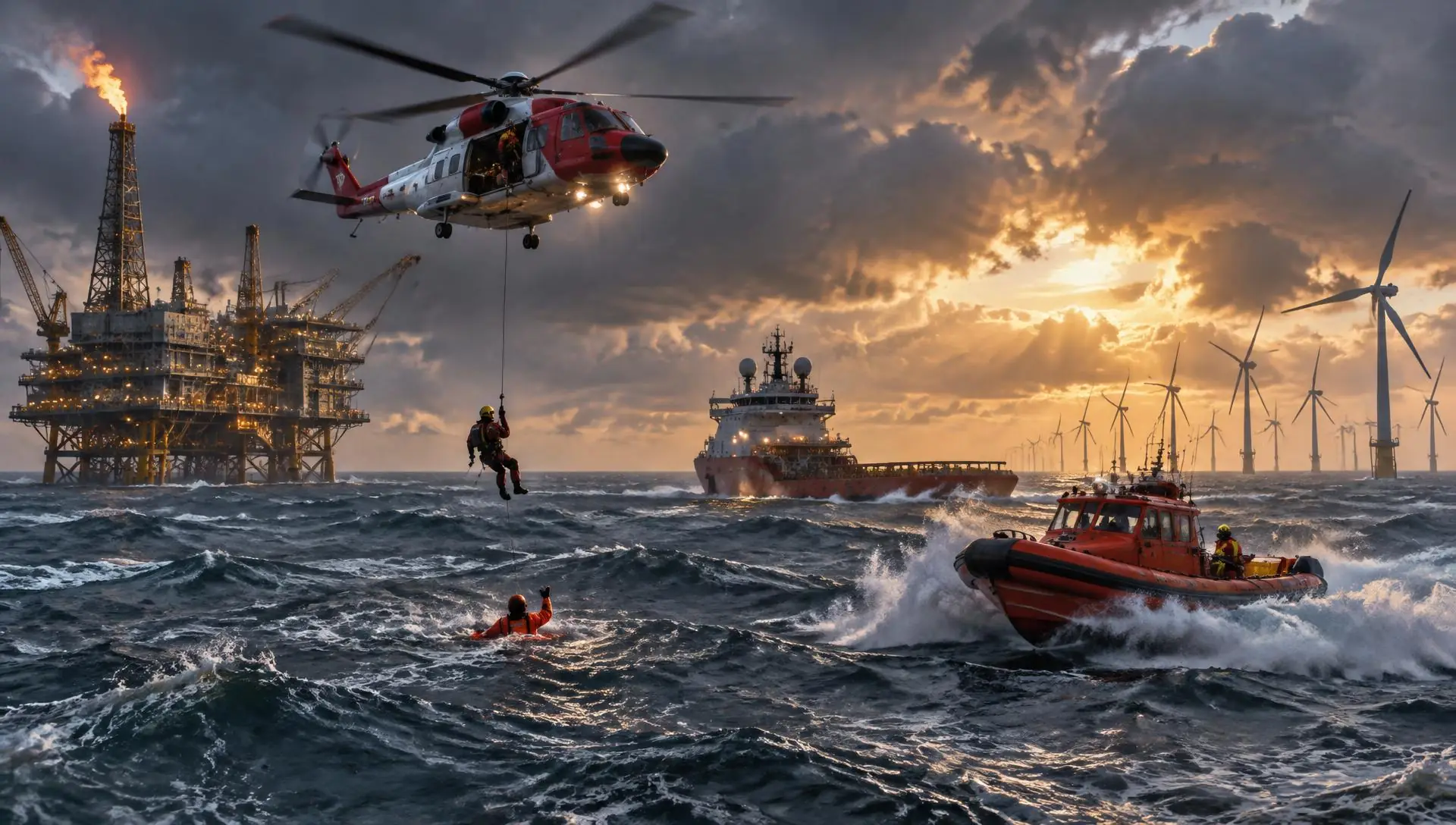
Offshore wind farms, oil and gas platforms, floating production units, drilling rigs, aquaculture sites and remote island facilities all share one hard fact: help from shore is far away without local rescue capability. Transit times, weather limits and helicopter range mean people on site must be able to look after themselves until external support arrives — and then work smoothly with it.
Regulators and industry bodies reflect this. Operators are expected to plan for evacuation, escape and rescue, to hold their own emergency equipment and backup communications, and to agree in advance with a respective authority how SAR aircraft and vessels will operate around their installation.
Two layers of response
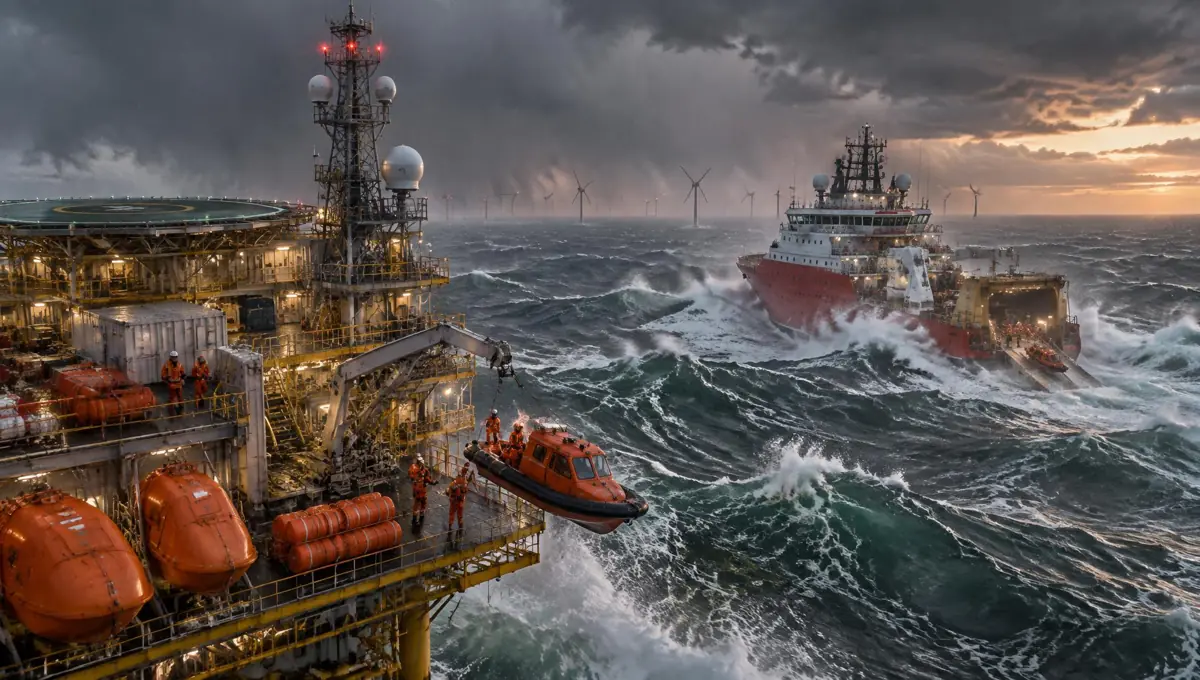
1. On-site Capability. Each installation should have its own emergency response team, rescue and survival equipment, backup power and redundant communications — sized to the realistic time before outside help can arrive.
2. External SAR. Coastguard (or other) helicopters and rescue boats may be hours away or grounded by weather. Far-offshore response often needs a mothership or standby vessel with long endurance, rough-weather capability and the ability to launch and recover daughter craft.
Training material
Much of offshore SAR is common to every site. Below, the shared core comes first, followed only by the topics that are genuinely different for each type of installation.
Offshore SAR — common to all sites
The foundation every offshore responder needs, whatever the installation.
- Distance and time: long transits, limited helicopter range and fuel, and why the first hour is usually on the installation's own resources.
- Rough-weather operations: sea state limits for small craft, recovery of persons from the water, cold-water shock and hypothermia.
- Alerting and coordination: notifying the MRCC/JRCC, the On-Scene Coordinator role (IAMSAR Vol. III), SITREPs and handover to external SAR.
- Mothership / standby-vessel concepts: endurance, daughter-craft launch and recovery, and on-scene medical care.
- Helicopter operations: winching, helideck and hoist procedures, and working with SAR aircraft.
Offshore oil & gas platforms
Distinct because of major-hazard scenarios and large crews.
- Fire, explosion and gas release (H₂S) — muster, temporary refuge and escalation decisions.
- Evacuation, Escape and Rescue (EER): lifeboats/TEMPSC, chutes, liferafts and helicopter evacuation (ISO 15544; UK PFEER-style duties).
- Standby / Emergency Response and Rescue Vessels (ERRV) and their fast rescue craft.
- Mass-casualty planning and accounting for everyone on board.
Offshore wind farms
Distinct because sites are often unmanned, spread out and accessed by small vessels.
- Rescue from height and confined spaces: nacelle, hub and tower evacuation, casualty lowering (GWO Basic Safety Training).
- Crew transfer vessel (CTV) and walk-to-work transfer incidents and person-overboard at the boat landing.
- SAR helicopter flight in and around turbine arrays: shutdown, lighting and 'lanes' agreed with the coastguard.
- Medical emergencies far from help: remote medical support, and technicians as first responders.
Other remote sites (FPSOs, rigs, aquaculture, island facilities) follow the common core plus whichever of the above hazards apply to them.
Human factors: Why People-Safety Must Be Mandatory Offshore
Offshore crews live and work together for weeks at a time, far from family, support services and any easy way out. There is nowhere to walk away from an interpersonal conflict, a bullying supervisor or a team that has stopped talking honestly and constructively. In that isolation, toxic team culture is not just a welfare problem. It is an operational hazard, a psychological and physical safety problem. It undermines the trust, communication and quick thinking that emergency response depends on.
For this reason, workplace psychosocial safety, healthy teamwork and ethical leadership should be treated as core safety requirements offshore, not optional extras or unstructured niceties. They belong alongside sea survival training and equipment checks. Crews must feel safe to report hazards, undergo ethics education, ego management, and trauma-informed leadership. They must admit mistakes and respectfully challenge unsafe decisions without fear of punishment. Leaders must model fairness, accountability and care, creating a fear-free environment. Punitive and blame cultures have no place in these environments.
- Psychological safety in SAR teams
- Healthy teams
- Ethical leadership
- SAR psychology
- Human factors SAR training
- SAR Human Factors Library
The Mayday Movement asks responders, operators and organisations to pledge to build psychologically safe first-response workplaces. Offshore operators and crews are warmly invited to join.
Interactive tools
Offshore SAR pattern tools (AACS)
Explore AACS for offshore wind farms: a pattern explorer, drift simulator, scenario map, AI search planner, AACS vs GALS comparison and the full research report. Join SoS for full access.
Open the Offshore SAR pattern tools →For the offshore rescue vessels, all-weather lifeboats and fast rescue boats that respond to these sites, see the SARfleet rescue boat database.
Emergency-readiness checklist generator
Describe your installation, the equipment you have and a scenario you want to prepare for. An AI model will draft a tailored readiness checklist you can review, print and adapt.
Checking your access…
Need an offshore readiness review?
The Spirit of SAR can review your emergency response plan, run drills and train your on-site responders.
Contact us