Search & Rescue beyond Earth
As human activity in orbit and beyond grows, so does the need to prepare for emergencies where no rescue service yet exists. AstroSAR (Astronautical SAR, or Space SAR) explores the intersection of SAR and spaceflight, how the operations, principles, systems and people of SAR can be extended to outer space.
The Spirit of SAR is spearheading this topic, developing concepts, research papers, commentary, content and presentations. The parallel between maritime operations and safety and astronautical operations and safety is an active project.
SoS Themes: innovation, concept development and industry progress.
AstroSAR is a concept-development and research initiative, not an operational rescue service. The environments and priorities below are areas for exploration, rather than validated procedures or established capabilities.
Space Rescue News, Presentations and Publications
2017
Resurrecting Space Guard: Concepts for a Coast Guard of Space
Paper by SoS Founder Robert J. Rovetto for the International Astronautical Congress (IAC-17), 28th IAA Symposium on Space and Society, session on Space Assets and Disaster Management (IAC-17,E5,4,10,x40148).
Read more →16 september 2026
SoS Founder Gives Presentation about Space Rescue
Speaking in webinar hosted by National University of Singapore, Center for International Law, "Protection, Resilience, and Legal Gaps in Dual – Use Space Systems". Presentation is about a chapter in a forthcoming book on spaceflight. Contact to purchase, or to hire SoS for talks.
Read more →Forthcoming
Who's to the rescue? The Impact of Dual-use on Astronautical Emergency Response
A forthcoming book chapter by SoS Founder Robert J. Rovetto, exploring the impact of dual-use on astronautical emergency response.
View the forthcoming book on Springer →Upcoming - STAY TUNED or EXPRESS INTEREST IN ATTENDING
Spacecraft in Search and Rescue (SAR): Communicators
Presentation on the role of satellite systems in distress alerting and SAR coordination. Date and venue to be announced — get in touch to host or co-host this talk. contact@thespiritofsar.com
Where might space rescue be needed?
Rescue beyond Earth is not a single problem. Each environment changes how a distressed person or spacecraft can be located, reached, assisted and brought to safety.
Earth orbit
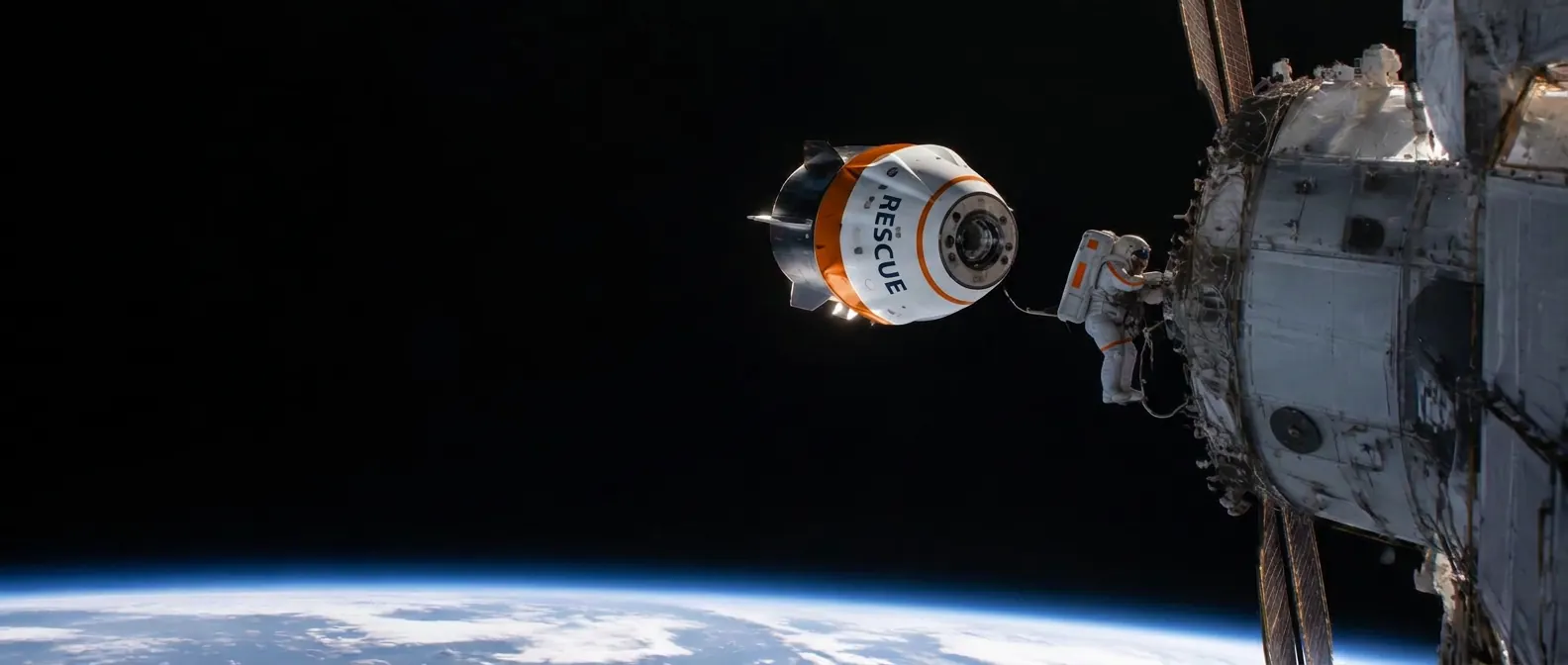
A disabled spacecraft, loss of propulsion or an astronaut emergency could require assistance from another spacecraft. Rendezvous depends on orbital geometry, available propulsion, compatible interfaces and the casualty’s remaining life-support time—not simply on which vehicle is nearest.
Cislunar space
Between Earth and the Moon, rescue planning must account for greater distances, transfer trajectories, communications coverage and potentially long response times. Safe-haven options and contingency supplies may be as important as a dedicated rescue vehicle.
Lunar and Planetary Surfaces
An incapacitated space explorer, a damaged rover or inaccessible habitat introduces terrain, navigation and casualty-transport challenges. Space Suit endurance, dust, temperature and access to a pressurized refuge shape the response.
Return to Earth
Off-nominal landings and splashdowns connect spaceflight directly with terrestrial and maritime SAR. Distress alerting, location information, tracking, recovery teams and medical handover need to work across the boundary between mission control, rescue authorities and/or tasks response vessels (contractors, agencies, organizations, companies, or other actors).
The Rescue Problem: Time, Access and Survival
Maritime SAR offers useful principles—early alerting, coordinated action, search planning and survivor care. Their application in space requires adaptation, innovation, new assumptions and evidence.
- Alerting and Location: establish how a distress signal, position, trajectory and casualty status can reach the people and technology able to respond, including when normal communications fail.
- Physical access: determine whether a responder can intercept, dock, approach or recover the casualty safely, with sufficient propulsion and resources for the onward journey.
- Survivability: consider breathable atmosphere, pressure, temperature control, power and medical needs against the earliest feasible arrival of assistance.
- Interoperability: examine docking, communications, suits and transfer arrangements so that communicating with and reaching a spacecraft does not leave responders unable to help.
- Human Factors: account for unique microgravity effects, fatigue, isolation, stress, workload, and shared situational awareness among astronauts, mission control and rescue partners.
- Responder safety: combined with human factors issues, assess collision, debris, contamination and resource depletion so that an attempted rescue does not create a second emergency.
Research and Development priorities
A useful space rescue framework must make its assumptions visible and distinguish what is technically possible from what is operationally ready. Questions for collaborative investigation include:
Coordination and Responsibility
Who is responsible to respond? Who's to the rescue? Who receives the alert, coordinates the response and commits resources across organizations, agencies, states and commercial operators? How should information, responsibilities, jurisdictions and decisions be shared before an emergency occurs?
Designing for Rescue-readiness
Which standards, common interfaces, emergency supplies, safe havens and casualty-transfer provisions would make mutual assistance more feasible? Where could unmanned systems support inspection, communications or delivery without assuming that they can recover people?
Scenarios, Training, Exercises and Validation
What can tabletop exercises, simulation and analogue environments reveal about response times, resource limits and decision-making? Any future models should state their inputs, uncertainty and limitations, and avoid presenting conceptual results as demonstrated rescue performance.
An International Foundation for Assistance
The Outer Space Treaty and the Agreement on the Rescue of Astronauts, the Return of Astronauts and the Return of Objects Launched into Outer Space provide an important legal foundation for assistance. They do not, by themselves, supply a rescue architecture or guarantee an available response. SoS aims to develop that architecture, with your support to sustain this currently in-kind research. Translating obligations into practical arrangements is a distinct operational challenge.
Space SAR at The Spirit of SAR
Our interest is in connecting SAR experience and SAR knowledge with the emerging needs of human activity beyond Earth: concept development, interdisciplinary dialogue, and opportunities to create and improve preparedness. The forthcoming book chapter forms part of this exploration. Let space be the place where we are prepared before a tragedy strikes.
Call to Action: We welcome researchers, space agencies, spacecraft owners/operators, engineers, medical specialists and SAR practitioners interested in co-developing research questions, contributing operational perspectives or exploring joint publications and exercises.
Collaborate on Space SAR
Partner with us as co-developers, co-researchers, co-authors and co-creators to explore rescue readiness beyond Earth.
Discuss a collaboration