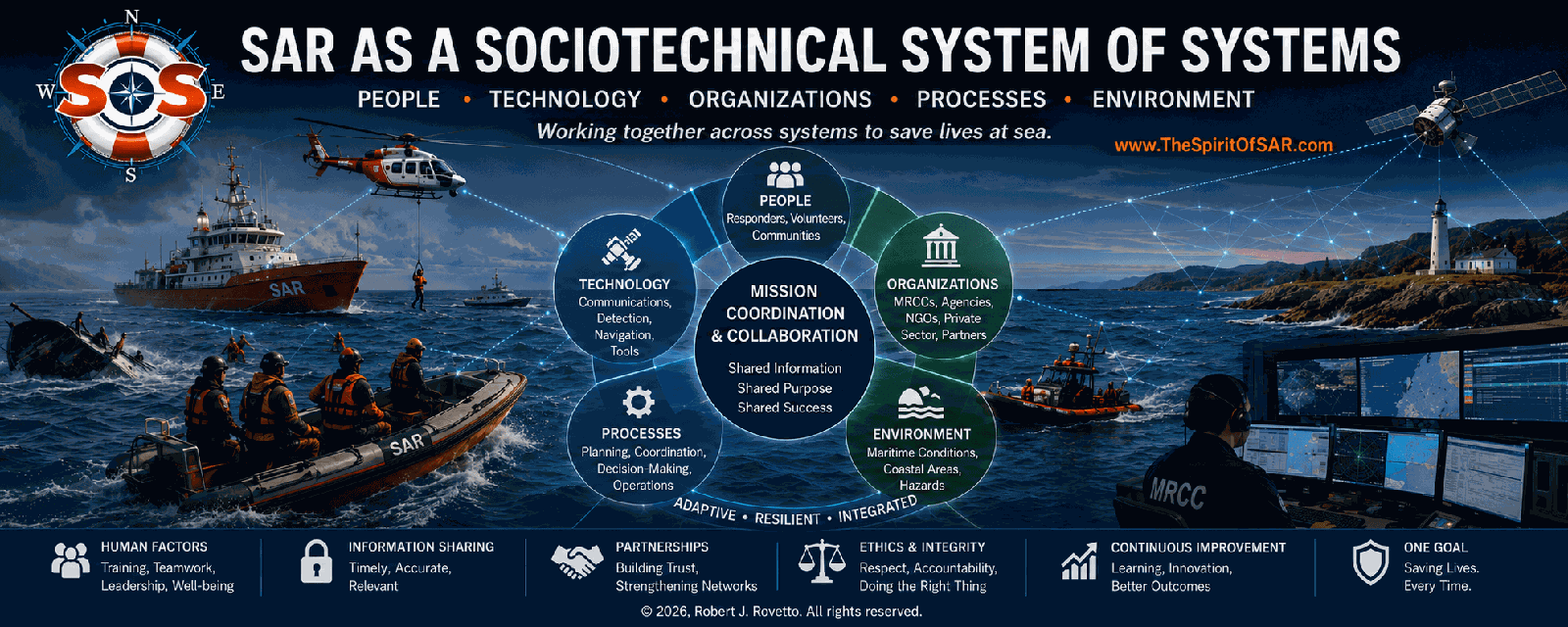
In the SoS article “What is Search and Rescue (SAR)?” SAR is described as a system of systems. More precisely, a SAR system is a socio-technical system of systems. What does that mean?
Socio = social
SAR is about people: interacting, cooperating, collaborating, coordinating, operating equipment — fundamentally, people helping people. Systematic SAR preparation and performance involves people training other people, and teams working together to rescue other people.
The public-safety, high-risk, life-and-death nature of SAR morally and professionally obliges us to maximise people-potential, training efficiency, and human flourishing. That obligation is what allows teams to keep improving toward higher degrees of operational excellence. That is the social side of SAR.
Etymology note: “socio” comes from the Latin socius — companion or ally. Apt for an activity whose purpose is helping people.
Technical = technological
SAR operations rely on engineered systems and applied science: communications and information distribution, vehicles, sensors, and personal protective equipment.
System of systems
A SAR mission is normally performed in a coordinated manner. It consists of several systems interacting and standing in relationships to one another toward a shared goal, each with a role to play in reaching it. It is therefore a system composed of other systems.
Social systems
- The individual first-responder or manager
- The team: boat crew, aircraft crew, land search party, K9 and handler, radio watchstanders, RCC team
- The organisation or authority: a government agency, a volunteer-based organisation, or a paid civilian SAR provider
Technical systems
- Communications and information distribution: ground networks and satellite systems
- Vehicles: aircraft, watercraft, land vehicles, unmanned aerial and aquatic vehicles
- Mobile and stationary equipment: radios, signalling devices, onboard rescue and recovery systems, cordage and rigging
Why it matters
If you treat SAR as purely technical, you buy equipment and wonder why performance stalls. If you treat it as purely social, you build a warm team that cannot execute. Improvement programmes have to address both — and the interfaces between them: procedures, training, communication and culture.
Summary
SAR does not exist without both — without the social interacting with the technical. SAR loses its purpose without the social. SAR loses most of its efficacy without the technical.
Safe Skies, Seas, Surfaces, and Spaces, SAR mates. — Founder, SoS
Design for both sides
SoS reviews teams and programmes across the social and technical halves of your SAR system, and delivers practical recommendations.
Get in touch